

Scan and Innovation Radar
In order that the socio-economic impacts of CCAM can be researched and modelled it is essential that a comprehensive analysis of the landscape is undertaken. This work implements a structured innovation scan of evolving knowledge across three areas of:
- PESTLE analysis
- Use cases
- Innovation scan
A summary of key findings to date are provided below followed by the detailed research reports on each which can be downloaded:
Structured Insights from the PESTLE Framework
At the heart of the CCAM-ERAS project is a clear goal: to understand how automation will impact the job market, what new types of skills will be needed, and how regulation must adapt to support these transitions. This element of the project is focused specifically on this mission by conducting a detailed PESTLE analysis—exploring Political, Economic, Social, Technological, Legal, and Environmental factors. This was done through structured interviews with key stakeholders from across industries, government, education, and more. Their real-world insights form the backbone of the findings.
Political Dimension: Aligning Strategies Across Europe
National differences in automated vehicle regulations present a major barrier. Stakeholders agreed that harmonised EU-wide policies are essential. Investments in smart infrastructure and joint public-private governance structures will support a safer and more competitive automated mobility ecosystem.
Economic Dimension: Overcoming Financial Barriers
Stakeholders expressed concerns over the high costs of CCAM deployment and uncertain return on investment. Public funding, innovation grants, and public-private partnerships were seen as critical tools for supporting both businesses and communities—especially in transitioning rural and underserved areas.
Social Dimension: Preparing People for New Careers
Job roles will shift—not disappear—with the rise of CCAM. There will be demand for new professions such as remote vehicle operators and system maintenance experts. Continuous learning, reskilling, and inclusion strategies must be part of national and local workforce agendas. Stakeholders also emphasized the need to combat public scepticism with targeted outreach and educational campaigns.
Technological Dimension: Building Reliable Digital Infrastructure
The successful deployment of CCAM depends on advanced infrastructure such as 5G networks, V2X communication, and secure data systems. Stakeholders also emphasized integrating automation into broader urban planning, including public transport and logistics.
Legal Dimension: Enabling Innovation While Ensuring Accountability
Legal clarity is essential. Stakeholders highlighted the need for updated liability frameworks, test zone regulations, and worker protection laws that reflect emerging job types in CCAM. EU-wide regulatory harmonization is needed for both testing and commercial deployment.
Environmental Dimension: Supporting Green and Sustainable Mobility
The environmental benefits of CCAM depend on clean energy integration and smarter transport management. Stakeholders noted the need for emission-reduction goals, green logistics planning, and circular economy practices in vehicle production.
Stakeholder Engagement: Insights from the Field
The PESTLE analysis was informed by structured interviews and three thematic workshops engaging representatives from transport, industry, education, government, and research. Their input was central to understanding sector-specific challenges and opportunities:
- Transport and Infrastructure: Automation is expected to boost operational efficiency but requires new workforce training and infrastructure investments.
- Society and Employment: Worker transition strategies, inclusive training initiatives, and awareness-building were highlighted as top priorities.
- Regulation and Policy: EU harmonisation, streamlined permitting, and cross-border legal clarity are critical for scaling CCAM.
Recommendations and Next Steps
- Develop national action plans for workforce transition aligned with CCAM technologies.
- Launch multi-sector training programs focusing on digital, technical, and safety skills.
- Create public communication strategies to raise awareness and acceptance of CCAM.
- Facilitate regulatory alignment across the EU with clear implementation roadmaps.
- Support research and testing environments through regulatory sandboxes and innovation hubs.
Read the full report here:
D3.1 CCAM Scan and PESTLE analysis
Usecases
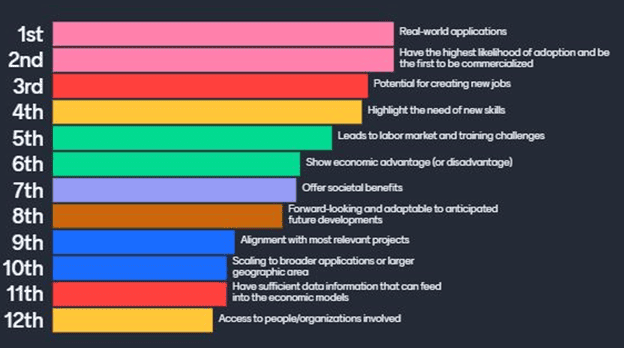
Using the outcomes of the PESTLE analysis a suit of usecases were selected to ensure the project's relevance, impact, and long-term viability was focused on real-world applications, commercial
potential, job creation, and addressing labor market and training challenges. This selction approach took a multidisciplinary approach which underscores the project's commitment to co-creation, ensuring the final use cases are robust and relevant. Section crierta was ranked as follows:
Selected usecases are:
Ground transportation for last-mile delivery
Focuses on automated solutions for distributing parcels and groceries to customers' doorsteps.
Bus depot
Involves automation in public transportation OEMs, operators, and logistics within bus depots.
Port/Terminal
Centres on logistical functions such as access control, charging, loading/unloading, and logistics planning in port and terminal operations.
Public (shared) transportation
Covers demand-responsive transport in urban areas, night transportation, and complementing rail transport in rural areas.
Private (shared) transportation
Includes robotaxi services and autonomous private hire or taxi market operations.
Shared transportation targeting specific groups
Offers mobility services tailored for people with disabilities, the elderly, and individuals in rural or low-accessibility areas.
These use cases were chosen to represent a broad spectrum of CCAM scenarios and to align with past and ongoing CCAM initiatives. The full usecase section and analysis report can be found below, which includes analysis of the type of transportation, vehicle type, level of automation, connectivity, capabilities, sensors, and operational design domain (ODD), adapting the recommendations described in the European Common Evaluation Methodology, developed by the FAME project.
D3.3 Final Selection of Use Cases
Innovation scan
Innovation Radar
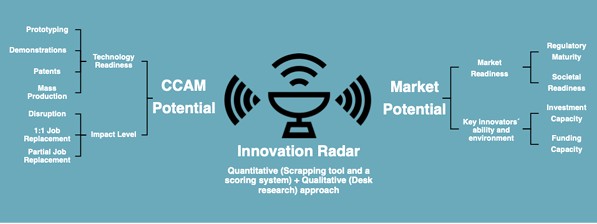
Alongside the PESTLE analysis and use case selection, CCAM-ERAS has implemented an Innovation Radar — a strategic tool for identifying and structuring innovations that could affect the future labour market and required skills. The radar tracks the relative maturity of CCAM technologies and key innovators, combining a quantitative data-mining and scoring methodology with qualitative desk research to produce a set of innovation profiles.
Two iterations to date
The first iteration (July 2025) piloted the methodology on a single measurement — CCAM prototyping activity — using an automated web-scraping and scoring system to surface the most promising developments, alongside an initial qualitative assessment of job impacts, job requirements, education needs, and regulatory maturity. The second iteration (July 2026) applies the full methodology across five key CCAM domains, each assessed for technology readiness, real-world deployment status, market readiness, and expected economic, social and environmental impacts.
Key findings
Across all five domains, CCAM is shifting from pilots toward early commercial deployment, though at markedly different speeds. Freight and remote operation are the most mature, already running unsupervised or lightly supervised commercial services, while shuttles, robotaxis and city logistics remain constrained by scaling, integration and business-model uncertainty. A consistent thread across all profiles is the growing centrality of AI and data — performance, safety and scalability increasingly depend on data quality, sharing and governance. Regulation emerges as both the key enabler and the key bottleneck: the UK's Automated Vehicles Act (2024) provides one of the most advanced legal frameworks globally, and the UNECE Working Party (GRVA) has adopted draft regulations paving the way for EU-wide harmonisation, but cross-border consistency, liability, and certification remain unresolved in most markets. Globally, 9 countries now permit commercial Level 4 deployment and 19 permit testing.
Recommendations
The reports recommend prioritising a single trusted data source over multiple scraping platforms to reduce overcounting; continuing to combine quantitative tracking with manual, targeted research to keep pace with a fast-moving field; and using the radar's mapping of technology, market and regulatory readiness to inform CCAM-ERAS's ongoing skills and labour market analysis, as well as broader strategic positioning discussions around European technological sovereignty.
Read the full reports here:
