

Schemes for the Developing Enhancing Skills
Skills foresight
This phase of the research project provides a forward-looking perspective on how Connected, Cooperative and Automated Mobility (CCAM) will reshape skills demand—focusing not on predicting job numbers, but on how work itself is evolving across the entire mobility system.
A central finding is the emergence of a structural shift from traditional, manual and mechanical tasks toward hybrid technical–digital roles. Across sectors, including manufacturing, logistics, maintenance, and passenger transport, work is becoming increasingly software-driven, data-enabled, and system-oriented. As a result, demand is rising for capabilities in software engineering, data analytics, cybersecurity, artificial intelligence, and systems integration, while purely mechanical and routine activities steadily decline.
The analysis also highlights that policy and governance are key drivers of skills change, often shaping demand as strongly as technological advancement. Regulatory requirements linked to safety, data protection, cybersecurity, and liability are accelerating the need for new competencies—particularly in areas such as compliance, system validation, and operational oversight—and are creating new points of pressure across both industry and public institutions.
Importantly, the transition is characterised less by job loss and more by task reconfiguration and role transformation. Existing occupations are evolving rather than disappearing: for example, drivers and technicians increasingly shift toward supervisory, diagnostic, and digitally supported roles, while entirely new positions—such as remote operators and system integrators—are emerging.
However, the findings underline significant challenges. Skills gaps are already evident and are expected to widen, driven by the mismatch between rapid technological change and slower adaptation in education and training systems. Shortages in digital and cybersecurity expertise, combined with capacity constraints in SMEs and public authorities, risk slowing CCAM deployment if not addressed.
Overall, this phase highlights that the successful transition to CCAM depends on building a workforce with cross-disciplinary, adaptable skillsets, supported by continuous upskilling, more flexible learning approaches, and stronger alignment between industry needs, education systems, and policy frameworks.
Read the full analysis here CCAM_ERAs_D4.5 Skills foresight report Final
Use Case Impact Analysis of skills
This work continued to translates the transition to CCAM into a set of concrete, real-world use cases, examining how impacts differ depending on operational context, deployment environment, and service model. This approach highlights that CCAM is not a single uniform shift, but a diverse landscape of applications, each with its own trajectory, benefits, and challenges.
The analysis focuses on a portfolio of use cases across both freight and passenger mobility, including:
- Automated operations in controlled logistics environments (e.g. ports, terminals, warehouses)
- Hub-to-hub and long-distance freight transport
- Urban and last-mile delivery services
- Shared automated mobility services (e.g. on-demand shuttles, robotaxis)
- Fixed-route automated public transport (e.g. buses and shuttle loops)
- Integrated mobility platforms and service ecosystems (e.g. Mobility-as-a-Service models)
A key finding is that deployment potential varies significantly across these use cases. Applications in controlled or semi-controlled environments—particularly in logistics and fixed-route operations—are more mature and scalable in the near term. These settings allow automation to deliver clear efficiency gains, cost optimisation, and operational predictability. In contrast, use cases operating in complex, mixed-traffic urban environments face slower progress due to greater technical uncertainty, regulatory constraints, and public acceptance challenges.
Across all use cases, the transition is best understood as a reconfiguration of tasks and operational models rather than wholesale replacement. Routine, repetitive activities are increasingly automated, while human roles evolve toward system supervision, remote operation, exception management, and service delivery functions. This results in a hybrid operating model where humans and automated systems are tightly integrated, particularly visible in logistics coordination and shared mobility services.
At the same time, the analysis shows that value creation shifts alongside these operational changes. Data becomes central to how services are delivered and optimised, enabling more integrated, responsive, and platform-based models. New service concepts—such as on-demand mobility and digitally coordinated logistics—emerge, supported by continuous data exchange and system interoperability.
However, several cross-cutting challenges remain consistent across use cases. These include uncertain business models in early deployment phases, fragmented regulatory environments, and varying levels of readiness across stakeholders and regions. These factors influence both the speed of adoption and the ability to scale solutions effectively.
Overall, this phase highlights that CCAM will evolve through a portfolio of use cases progressing at different speeds, requiring targeted, context-specific strategies to unlock their full operational, economic, and societal potential.
Read the full report here D5.1 Report analysing the impact of CCAM on each use case
Occupational profiles for educational instruments
Enhancing CCAM deployment across Europe brings distinct human capital challenges. This report takes a use-case approach to provide a sound basis for developing the educational schemes and actions needed to address them, drawing on the same six use cases developed elsewhere in the project: ground transportation for last-mile delivery, bus depot, port/terminal, public (shared) transportation, private (shared) transportation, and shared transportation targeting specific groups.
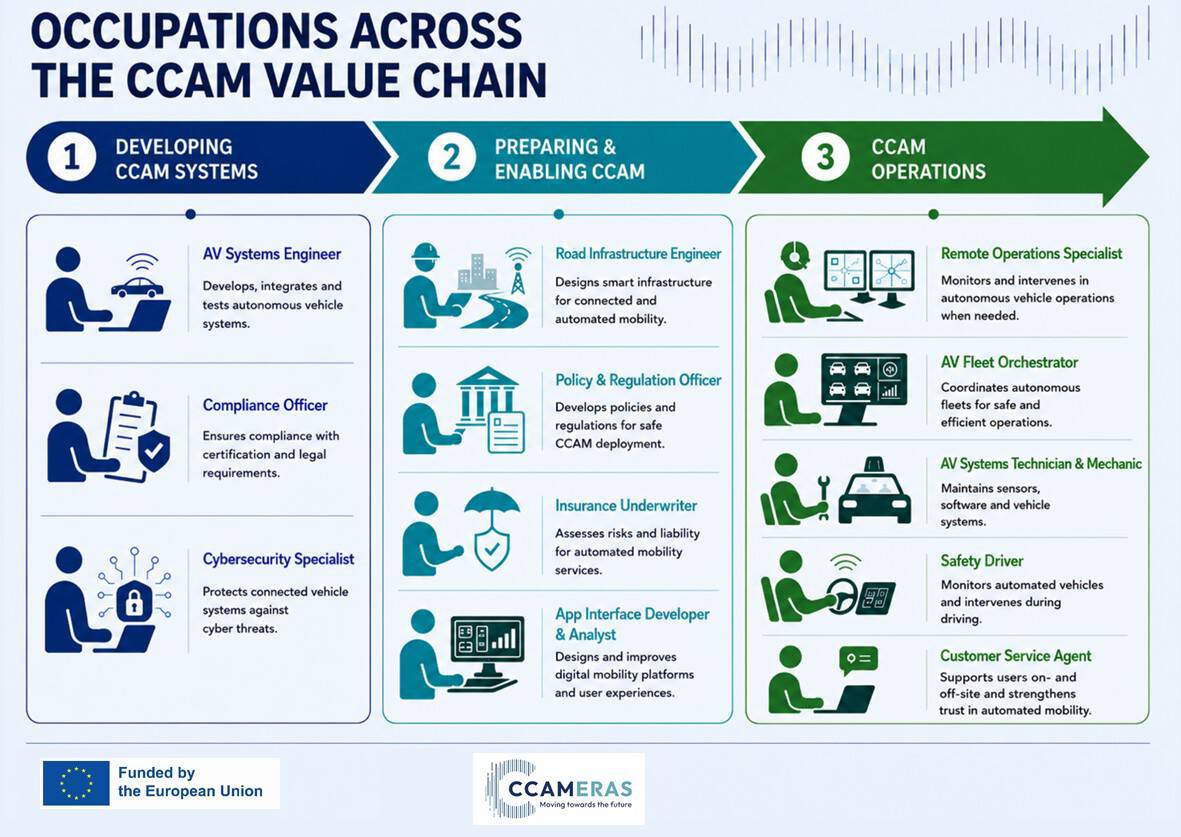
Key findings
Evidence from across CCAM-ERAS suggests the risk of unemployment from CCAM deployment is low, given Europe's tight labour market — the real challenge lies in finding the human capital needed to enable deployment in the first place. Human capital needs are broadly similar across use cases, varying more by the development phase of a given CCAM deployment than by the use case itself.
From an inventory of the tasks underpinning these use cases, twelve occupations were identified and clustered into four groups: CCAM operations (customer service agents, fleet orchestrators, remote operations specialists, technicians, safety drivers), preparing and enabling CCAM (infrastructure planning and engineering roles), policy and regulation (policy officers, insurance underwriters, app interface developers), and developing CCAM systems (AV systems engineers, compliance officers, cybersecurity specialists). The longlist spans both technical and non-technical roles, and both mid-level and highly educated professionals.
Co-creation sessions and interviews added depth on professional backgrounds and skills gaps. Technical occupations (mechanics, engineers) have a strong formal education base and mainly need to keep pace with fast-moving technology — best supported through short courses alongside formal education. Non-technical occupations need an added layer of CCAM-specific competence on top of their core skills, which non-formal and informal learning (short courses, on-the-job training, learning-by-doing) is often better placed to deliver than changes to formal curricula.
Recommendations
Because professional backgrounds are so diverse, a variety of learning pathways is needed, built around clearly defined learning outcomes. Two occupations were selected for detailed elaboration into full occupational profiles with learning outcomes: the Remote Operations Specialist (EQF level 3) and the Policy & Regulation Officer (EQF level 6), both seen as pivotal to CCAM development. The report recommends employers, sector organisations, governments and educational providers use these profiles — and the wider longlist — as the basis for developing tailored educational provision.
Read the full report here: Deliverable D5.2_Occupational profiles for educational instruments Final
Recommendations and Conditions for Success
CCAM is expected to play a transformative role in the future of European transport, improving safety, efficiency, sustainability and accessibility across a wide range of mobility services. Yet successful deployment depends on far more than technological progress alone — it requires a coordinated transition that prepares organisations, workforces, regulatory frameworks and governance systems for widespread adoption.
A synthesis, not new research
Deliverable 5.3, the final output of Work Package 5, brings together evidence from across the CCAM-ERAS project — the representative use cases, stakeholder engagement, socio-economic analyses, workforce assessments and educational recommendations — into a coherent set of strategic recommendations for deploying CCAM beyond the project's own context. Rather than generating new empirical research, it integrates existing project knowledge to identify common deployment challenges, enabling conditions and strategic priorities, taking a cross-sectoral view that looks for recurring patterns across different operational environments and transport domains.
Key findings
The deliverable frames the transition to CCAM as a socio-technical transformation, not simply a technological one. Across the use cases, automation consistently reshapes occupational roles, organisational processes and stakeholder interactions, while increasing the importance of digital competencies, interdisciplinary collaboration and continuous learning. Workforce readiness, organisational capacity, regulatory certainty and stakeholder cooperation are identified as the critical factors determining whether automated mobility systems can be deployed successfully.
Recommendations
Building on these findings, the report sets out the conditions needed for successful CCAM deployment and directs targeted recommendations at the principal stakeholder groups across the European mobility ecosystem: European institutions, national governments, industry and technology providers, transport operators, education and training providers, and the research community. Throughout, the emphasis is on coordinated action — aligning technological innovation with workforce development, regulatory evolution, organisational preparedness and knowledge exchange. Education and lifelong learning are given particular weight, with the report calling for flexible learning pathways, continuous competence development, and closer collaboration between education providers, employers and policymakers to prepare current and future CCAM professionals.
Taken together, Deliverable 5.3 offers an integrated view of what is needed to support a scalable, socially responsible rollout of CCAM across Europe, translating the project's evidence into practical recommendations for policy, industry, education and research.
Read the full report here: D5.3 - Recommendations and conditions for success and further exploitation outside the context of the use cases_v_1.0_Final_Sub
Seminar training course
On 25 June 2026, SAAM held the first in a planned series of training seminars under CCAM-ERAS Work Package 5 (D5.2 Educational Instruments), bringing 23 representatives from German-, French- and Italian-speaking Swiss cantons together in Bern. The day aimed to build a shared understanding of automated vehicle (AV) opportunities and challenges, cover the regulatory, operational, safety and economic landscape, identify the competencies public administrations will need, and help participants gauge their own readiness — since under Switzerland's new Ordinance on Automated Driving (VAF), cantons hold the authorisation competence for driverless operation.
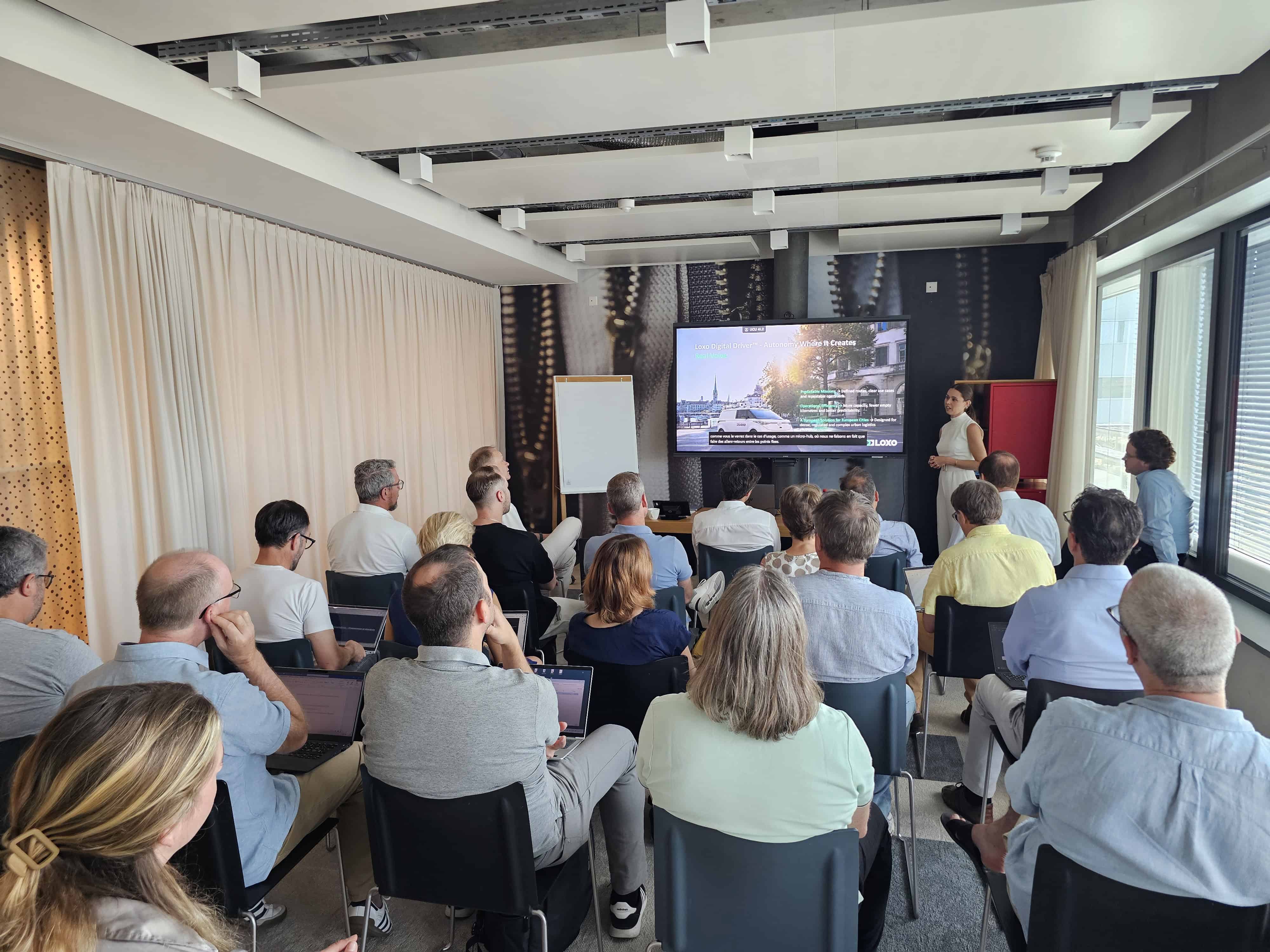
Five modules structured the day:
- Use Cases & Technology, which grounded the discussion in real Swiss deployments (LOXO's Bern delivery robot, ARTOUR's Arbon bus, Zurich Airport shuttles, among others);
- Regulation, Ordinance & Directives, covering the legal basis and the three-step authorisation process;
- Operational Readiness, Safety & Data, introducing Safety Management Systems and incident-handling frameworks;
- Business & Sustainability, addressing economic pathways and authorities' role as market shapers;
- Acceptance & Adoption, covering new competencies administrations will need and EU-level policy recommendations.
The findings were candid. An opening baseline poll put average cantonal authorisation-readiness at just 2.7/10, and a post-event competency self-assessment averaged 2.38/5, with over half of responses at the lowest confidence levels — lowest of all on core authorisation tasks like assessing operator safety and formulating operator requirements. Satisfaction was high (4.4/5) even where the day left professional needs only partly met (3.5/5), reflecting its intentionally introductory scope. Participants consistently asked for deeper, more applied follow-up sessions — particularly a practical walkthrough of the cantonal authorisation process.
Read the full report here D5.3_Seminar_report_Final
